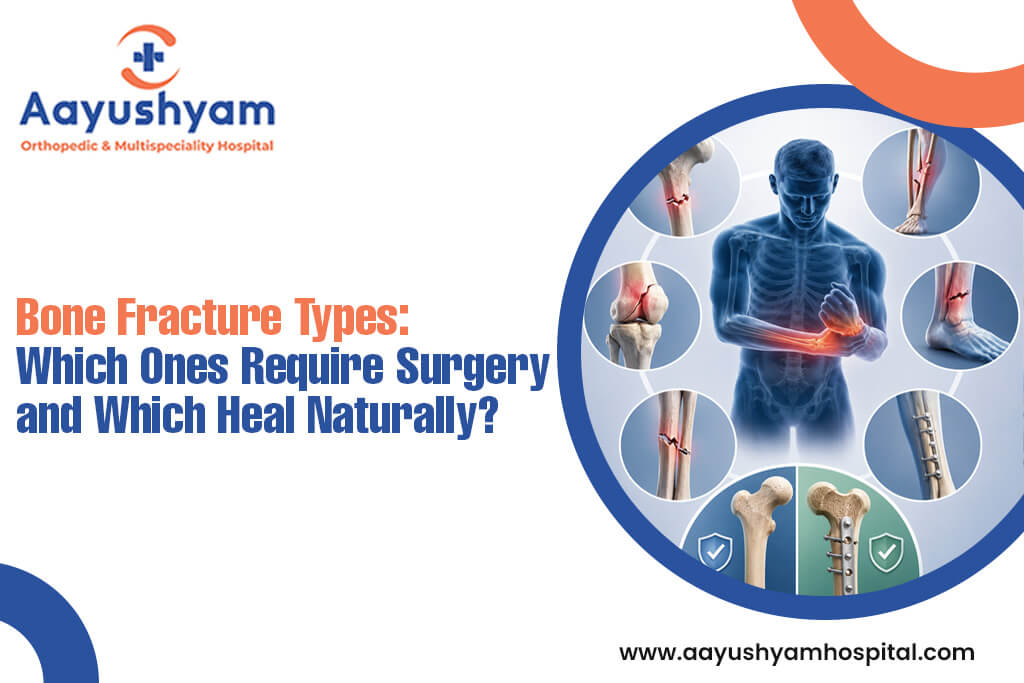
Bone Fracture Types: Which Ones Require Surgery and Which Heal Naturally?
Quick Answer: Not all bone fractures require surgery. Stable, non-displaced, and closed fractures often heal naturally with immobilization such as a cast or brace. Surgery is generally recommended for displaced, open, unstable, comminuted, or joint-related fractures to restore proper alignment and function. An orthopedic specialist determines the appropriate treatment after clinical examination and X-rays.
Key Takeaways
✔ Not every fracture requires surgery.
✔ Closed and stable fractures often heal naturally.
✔ Open fractures require emergency treatment.
✔ Surgery is recommended when bones are displaced or unstable.
✔ Early diagnosis improves recovery.
A sports injury, car accident or accidental fall can lead to painful bone fractures. In such unfortunate cases, one question that always comes to mind is: Will I need surgery? One of the common assumptions is that a fractured bone always means an operation, though it is far from the truth. Fracture treatment is typically tailored to the specific nature. In this blog, we will discuss the types of fractures, factors orthopedic surgeons consider when deciding between surgical and non-surgical interventions and what influences this important decision.
What is a Bone Fracture?
A bone fracture happens when a bone is exposed to a strong force that it is unable to withstand. It is a term used to define a broken bone. Fractured bones can be a result of a road accident, sports injury or built slowly through repeated stress, as seen in athletes and sportspersons. In some people, the bone itself is already weakened by osteoporosis, low vitamin D or certain diseases, so that even a minor knock is enough to cause a break. Whatever the cause, the goal of treatment is always the same: bring the broken ends back into their correct position and hold them there, steadily, until the bone knits itself back together.
How Does Orthopedic Doctors Classify Fractures?
Before deciding on treatment, the orthopedic doctor in Vadodara at Aayushyam Orthopedic & Multispeciality Hospital looks at two basic questions about the fracture:
#1 Is The Skin Broken?
The orthopedic doctor checked whether it was a closed fracture. In this, the bone breaks, but the skin stays intact. These injuries carry a lower risk. On the other hand, in open fractures, the broken bone pierces through the skin, or the wound reaches down to the bone. These injuries are more serious, carry a high risk of infection and are treated as emergencies.
#2 Is The Bone Still Aligned?
They check whether it is a non-displaced fracture. In this, the bone cracks, but the piece stays in its normal position. These fractures most likely to heal naturally. While in a displaced fracture, the broken bone end moves out of line. The greater the displacement, the more likely surgery becomes.
What are the Common Types of Bone Fractures?
Here are the fracture types we see at the top orthopedic hospital in Gotri and what each one usually means for treatment.
➤ Hairline (Stress) Fracture: A tiny crack caused by repeated stress rather than a single injury. Common in runners and athletes. Usually heals naturally with rest.
➤ Greenstick Fracture: The bone bends and cracks on one side without breaking fully, like a green twig. Seen mostly in children, whose bones are soft and flexible. Usually heals naturally with a cast.
➤ Transverse Fracture: A straight, horizontal break across the bone, often from a direct blow. May heal in a cast if stable, or may need surgery if displaced.
➤ Oblique Fracture: A diagonal break across the bone. Because the angled edges tend to slip, these often need close monitoring and sometimes surgery.
➤ Spiral Fracture: A break that twists around the bone, usually caused by a twisting injury. Frequently unstable and often requires surgery.
➤ Comminuted Fracture: The bone shatters into three or more pieces, usually from high-impact trauma. Almost always requires surgery.
➤ Segmental Fracture: The same bone breaks in two separate places, leaving a "floating" segment in between. Usually needs surgery.
➤ Compression Fracture: The bone collapses on itself, most often in the spine, and is commonly linked to osteoporosis. Treatment varies from bracing to surgery depending on severity.
➤ Avulsion Fracture: A small fragment of bone is pulled away by a tendon or ligament. Treatment depends on how far the fragment has moved.
Which Fractures Usually Heal Naturally?
Many fractures do not need an operation at all. A fracture is a good candidate for non-surgical healing when:
➤ The bone is non-displaced, meaning the pieces are still in their proper position
➤ The fracture is stable and unlikely to shift
➤ The break is closed, with no wound over it
➤ It affects bones that heal well, such as the wrist, forearm, collarbone, ankle or toes
➤ The patient is otherwise healthy, with good bone quality
For these fractures, the body does the real work. The orthopedic team simply creates the right conditions for healing through non-surgical methods:
➤ Immobilisation: A plaster cast, splint or brace holds the bone still so it can knit correctly. This is the most common fracture treatment.
➤ Closed Reduction: If the bone is slightly out of line, the doctor gently manoeuvres the pieces back into position without any incision, often under local anaesthesia, before applying a cast.
➤ Functional Bracing: A supportive brace that holds the bone while allowing limited, controlled movement of nearby joints.
➤ Rest and Activity Modification: Giving the injured area the time and protection it needs to recover, especially in stress fractures.
Which Fractures Usually Require Surgery?
Surgery becomes necessary when the bone simply cannot heal properly on its own. This is usually the case when:
➤ The fracture is significantly displaced and cannot be held in place by a cast alone
➤ The bone has broken into multiple pieces (comminuted)
➤ It is an open fracture that pierced the skin, carrying infection risk
➤ The fracture involves a joint surface, where even small misalignment affects movement
➤ The break is unstable, or earlier non-surgical treatment has failed to align it
➤ It affects weight-bearing bones like the hip or thigh, where stability is critical
When surgery is needed, the orthopedic surgeon in Vadodara has several proven techniques:
➤ Open Reduction and Internal Fixation (ORIF): The surgeon opens the site, realigns the bone, and fixes it in place with plates, screws, rods or pins. This is the most common fracture surgery.
➤ Intramedullary Nailing: A metal rod is inserted into the hollow centre of long bones, such as the thigh or shin, to support them from within.
➤ External Fixation: Pins placed into the bone are connected to a frame outside the body, often used temporarily for open or severely damaged fractures.
➤ Joint Replacement: In some serious fractures near a joint, especially the hip in older patients, replacing the joint may give the best long-term result.
The Role of Recovery and Physiotherapy
Whether a fracture is treated with a cast or with surgery, the healing does not end when the bone joins. Weeks of immobility leave muscles weak and joints stiff. This is where structured rehabilitation matters. Our physiotherapist in Vadodara designs a recovery plan that gradually restores strength, flexibility and range of motion, so that you return not just to a healed bone but to full, confident movement.
Good nutrition supports this process too. A diet rich in calcium and vitamin D, adequate protein, and avoiding smoking and excess alcohol all help bones heal faster and stronger.
The Takeaway
So, do all fractures require surgery? No. The truth is more encouraging. Stable, non-displaced and closed fractures often heal naturally with a cast and time, while displaced, comminuted, open or joint-related fractures usually need surgery to heal correctly. What matters most is an accurate diagnosis and timely treatment, because the same bone, treated early and correctly, almost always heals well.
If you or a loved one has suffered a fall or injury in Vadodara, do not wait to find out which type it is. Visit Aayushyam Orthopedic & Multispeciality Hospital, where our fracture specialists diagnose precisely, treat with care, and support you all the way from injury to full recovery.
FAQs
Do all bone fractures need surgery?
➤ No. Many fractures, especially stable, non-displaced and closed ones, heal naturally with a cast, splint or brace and enough time. Surgery is generally reserved for fractures that are displaced, unstable, broken into several pieces, open, or involve a joint.
How can I tell if my fracture needs surgery?
➤ Only an orthopedic doctor can decide, usually after an X-ray. In general, if the bone is out of position, shattered, piercing the skin, or affecting a joint surface, surgery is more likely. If the bone is cracked but still aligned, non-surgical treatment often works well.
How long does a fracture take to heal?
➤ Most simple fractures heal in about 6 to 8 weeks, but this varies with the bone involved, the type of fracture, your age and your overall health. Larger weight-bearing bones like the thigh can take several months to fully recover.
Can a displaced fracture heal without surgery?
➤ Sometimes. If the displacement is minor, the doctor may realign the bone with a closed reduction and hold it in a cast. But significantly displaced or unstable fractures usually need surgery to heal in the correct position.
Is an open fracture always an emergency?
➤ Yes. An open fracture, where the bone breaks through the skin, carries a high risk of infection and needs urgent medical care, usually including surgery to clean the wound and stabilise the bone.
Why does pain sometimes continue after the bone has healed?
➤ Lingering pain after healing is often due to muscle stiffness, joint restriction or incomplete rehabilitation rather than the bone itself. Guided physiotherapy usually helps resolve it.
Disclaimer: This article is for general health awareness and educational purposes only. It is not a substitute for professional medical advice, diagnosis or treatment. Always consult a qualified orthopedic doctor regarding the diagnosis and treatment of any injury.