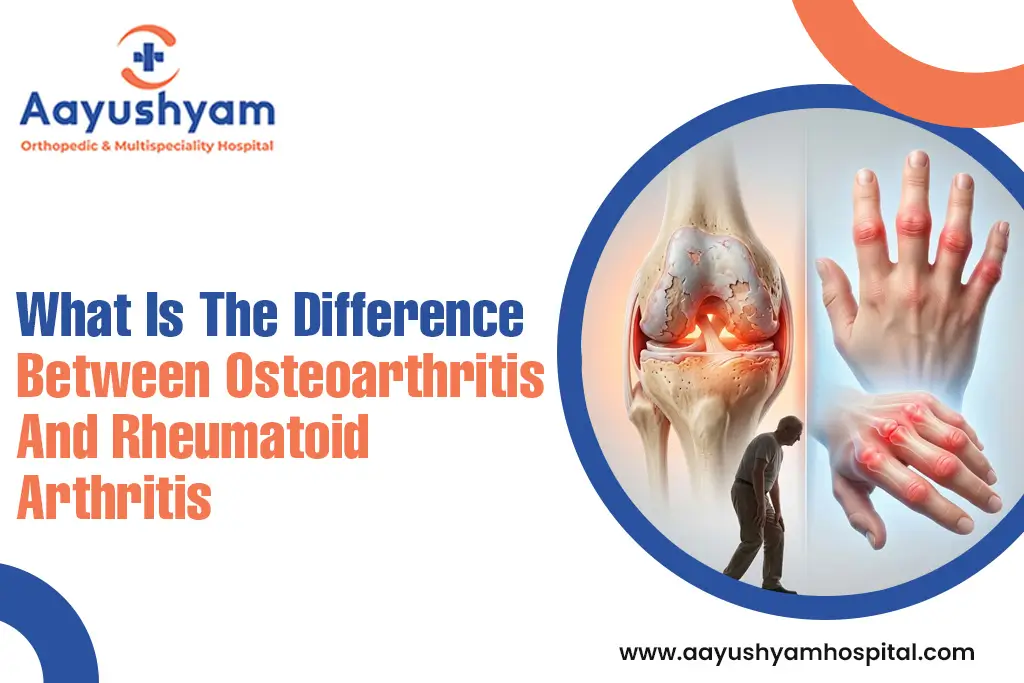
What is the Difference Between Osteoarthritis and Rheumatoid Arthritis
You've noticed your knees aching every morning. Your fingers feel stiff and swollen. Some days, even climbing a flight of stairs feels like a battle. A quick search tells you it could be "arthritis", but then you find out there are over 100 types of arthritis. The two most common? Osteoarthritis (OA) and Rheumatoid Arthritis (RA). They sound similar. RA vs OA both cause joint pain. But they are fundamentally different diseases with different causes, different warning signs, and very different treatment approaches. Confusing one for the other can mean years of wrong treatment, unnecessary suffering, and avoidable joint damage. This blog breaks it all down, clearly and completely, so you can recognise what your body is telling you and take the right action.
What Is Osteoarthritis (OA)?
Osteoarthritis is the most common form of arthritis worldwide. It is often called "wear and tear" arthritis because it develops when the protective cartilage that cushions the ends of your bones gradually breaks down over time. Think of cartilage as the shock-absorbing rubber pad between two bones in a joint. When this pad wears thin, bones begin to rub directly against each other, causing pain, swelling, stiffness, and eventually, loss of movement.
OA is a degenerative disease that progresses slowly over years and decades, and is most commonly seen in older adults. However, it can also affect younger people who have experienced joint injuries, are overweight, or do repetitive high-impact physical work. If you are experiencing severe joint pain, visit Aayushyam Orthopedic Hospital in Vadodara for diagnosis and effective treatment. Maintaining joint health through lifestyle changes may reduce future complications. Explore tips for keeping joints healthy.
Joints Commonly Affected by Osteoarthritis:
- Knees (the most common site in India)
- Hips
- Lower spine and lower back
- Hands and finger joints
- Neck (cervical spine)
What Is Rheumatoid Arthritis (RA)?
Rheumatoid Arthritis is a fundamentally different disease. It is not caused by wear and tear; it is an autoimmune disease, meaning your body's own immune system mistakenly attacks the lining of your joints (called the synovium). This leads to chronic inflammation, joint damage, pain, and swelling.
Unlike OA, which is confined to the joints, RA is a systemic disease that can affect your entire body, including the eyes, lungs, heart, skin, and blood vessels. RA can strike at any age, including children (Juvenile RA), young adults in their 30s and 40s, and older adults. It is significantly more common in women, who are two to three times more likely to develop RA than men.
Joints Commonly Affected by Rheumatoid Arthritis:
- Fingers and knuckles
- Wrists
- Ankles and feet (toes)
- Knees
- Shoulders and elbows
Osteoarthritis vs Rheumatoid Arthritis: The Key Differences at a Glance
| Feature | Osteoarthritis (OA) | Rheumatoid Arthritis (RA) |
| Nature of disease | Degenerative (wear & tear) | Autoimmune (immune attack) |
| Who it affects | Usually, 50+ years; can affect younger people with risk factors | Any age; peak onset 30-60 years |
| Gender pattern | Slighlty more common in women after 55 | Significantly more common in women (2-3x) |
| Joints affected | Knees, hips, spine, hands | Fingers, wrist, ankles, symmetrical |
| How it starts | Gradually, over the years | Can develop rapidly over weeks/months |
| Morning stiffness | Brief, typically under 30 minutes | Prolonged, often 1 hour or more |
| Pain pattern | Worsens with activity, better with rest | Present at rest; worse after long inactivity |
| Inflammation | Mild to moderate, localised | Significant, can be systematic |
| Systemic symptoms | None, confined to joints | Fatigue, fever, weight loss possible |
| Other organ involvement | No | Yes, eyes, lungs, heart, skin |
| Blood test markers | Usually normal | Positive RF, Anti-CCP often present |
| X-ray findings | Joint space narrowing, bone spurs | Joint erosion, bone damage |
| Treatment approach | Pain management, physiotherapy, joint replacement | DMARDS, biologics, steroids, physiotherapy |
| Can it be cured? | No, managed | No, it can be put into remission |
RA vs OA: Symptoms
Osteoarthritis (OA) Symptoms: What Patients Describe
- Pain that builds gradually over months and years, not overnight
- Worse after activity, the knee hurts more after a long walk, climbing stairs, or standing for long periods
- Improves with rest if you sit or lie down, the pain eases
- Morning stiffness that lasts less than 30 minutes, you "warm up" and start to feel better
- Grating or grinding sensation in the joint (called crepitus), you may actually hear or feel the joint creak
- Bony enlargements around the joint that you can feel with your finger
- Reduced range of motion over time, you can't bend the knee or hip as far as before
- One side may be worse. OA doesn't have to be symmetrical
Rheumatoid Arthritis (RA) Symptoms: What Patients Describe
- Pain and swelling in small joints, first the knuckles, finger joints, and wrists, are often the first to be affected.
- Prolonged morning stiffness lasting over an hour, sometimes until mid-morning or longer; the longer the stiffness, the more active the inflammation
- Symmetrical joint involvement in both hands, both wrists, and both ankles affected at the same time.
- Joints that are warm and visibly swollen, not just painful, but hot and puffy to the touch
- Fatigue that can be severe, not ordinary tiredness; a deep, persistent exhaustion that doesn't go away with sleep
- Low-grade fever, unexplained weight loss during active disease phases
- Rheumatoid nodules firm, painless lumps under the skin near joints, in some patients
- Flares and remissions, the disease can be relatively quiet, then suddenly worsen
If you are experiencing the above symptoms, consult Dr.Uday Meghnathi, an Osteoarthritis and rheumatologist specialist in Vadodara with years of experience in the orthopedic field.
Causes: Why Do These Conditions Develop?
What Causes Osteoarthritis?
OA is not inevitable with age, but ageing is the strongest risk factor. The cartilage gradually loses its elasticity and ability to repair itself. Contributing factors include:
Non-modifiable (you can't change these):
- Age - the older you are, the higher the risk
- Gender - women are more prone, especially after menopause
- Genetics - OA can run in families; inherited joint shapes can predispose certain people
- Previous joint injury - a fracture, ligament tear, or sports injury years ago- can trigger OA in that joint
Modifiable (you can do something about these):
- Obesity - every extra kilogram puts approximately 4–6 kg of additional load on the knee joint
- Repetitive joint stress - occupations requiring heavy lifting, kneeling, or squatting for years (farmers, construction workers)
- Muscle weakness - especially weak quadriceps (thigh muscles), which fail to properly support and protect the knee
- Sedentary lifestyle - inactivity weakens muscles and reduces joint lubrication
What Causes Rheumatoid Arthritis?
The exact trigger for RA is not fully understood, but it involves a combination of factors that cause the immune system to misfire:
- Genetic predisposition - certain genes (HLA-DR4 and others) increase susceptibility to RA; family history raises risk.
- Gender -female hormones appear to play a role, as RA is much more common in women and sometimes improves during pregnancy
- Environmental triggers - prolonged cigarette smoking is the single most well-established modifiable risk factor for RA; it doubles the risk.
- Infections - certain bacterial or viral infections may trigger the autoimmune response in genetically susceptible individuals.
- Hormonal changes - RA onset or flares sometimes coincide with hormonal events in women.
Treatment: What Can Be Done?
Treating Osteoarthritis
There is no cure for OA, but it can be very effectively managed to preserve function and reduce pain:
Lifestyle changes (the foundation):
- Weight management - losing even 5–10% body weight significantly reduces knee pain in OA.
- Low-impact exercise - swimming, cycling, and walking- strengthens muscles around the joint and reduces pain without damaging cartilage.
- Avoiding activities that aggravate the joint - modifying how you move and work.
Physiotherapy:
- Targeted muscle strengthening, especially the quadriceps, for knee OA
- Gait correction, joint protection techniques, and heat/cold therapy
- Aids like knee braces or orthopaedic footwear
Medications:
- Paracetamol and NSAIDs for pain and inflammation
- Topical gels for localised relief
- Intra-articular (into-the-joint) steroid or hyaluronic acid injections for moderate-to-severe cases
Surgical options (when other treatments fail):
- Arthroscopy - keyhole surgery to clean the joint
- Osteotomy - realigning bones to redistribute load
- Total or Partial Knee / Hip Replacement (Arthroplasty) - replacing the damaged joint with an artificial implant; highly effective with excellent long-term outcomes. Patients often want to understand the joint replacement recovery timeline before considering surgery.
Treating Rheumatoid Arthritis
RA treatment has improved dramatically in recent years. The goal is to achieve remission (no active disease) or, at minimum, low disease activity.
Disease-Modifying Anti-Rheumatic Drugs (DMARDs):
- Methotrexate is typically the first-line medication; it slows or stops joint damage
- Hydroxychloroquine, sulfasalazine, and leflunomide are other commonly used DMARDs
Biologic Agents:
- A newer class of medications that target specific parts of the immune system
- TNF inhibitors, IL-6 inhibitors, and others are now available in India
- Significantly improve outcomes for patients who don't respond to conventional DMARDs
Corticosteroids:
- Prednisolone and similar drugs provide rapid relief during flares
- Used short-term due to long-term side effects
Physiotherapy:
- Essential for maintaining joint mobility, preventing deformity, and building strength
- Occupational therapy for joint protection during daily activities
Surgery (in advanced cases):
- Synovectomy (removal of inflamed joint lining)
- Joint replacement for severely damaged joints
Orthopedic Care for Arthritis at Aayushyam Hospital, Vadodara
At Aayushyam Orthopedic & Multispeciality Hospital, our orthopedic specialists in Vadodara, Dr. Uday Meghnathi and Dr. Sumit Dabhi, bring deep expertise in diagnosing and treating all forms of arthritis, joint pain, and bone disorders across all age groups.
We offer comprehensive orthopedic care under one roof, including:
- Expert clinical consultation for joint pain, arthritis, and bone disorders
- Digital X-Ray and Ultrasound (USG) for on-site joint imaging
- In-house pathology for rapid blood test results (RF, Anti-CCP, CRP, ESR, and more)
- Physiotherapy with Dr Richa Goswami for rehabilitation and joint function recovery
- Joint replacement surgery - partial and total knee and hip arthroplasty
- Arthroscopy for minimally invasive joint procedures
- Rheumatoid arthritis management with specialist care
- Mediclaim facility for hospitalized patients
- 24×7 Emergency & Trauma Care for acute joint injuries
Whether you're dealing with early-stage joint stiffness or advanced arthritis requiring surgical intervention, our team will guide you to the right diagnosis and the most appropriate treatment with compassion and precision.